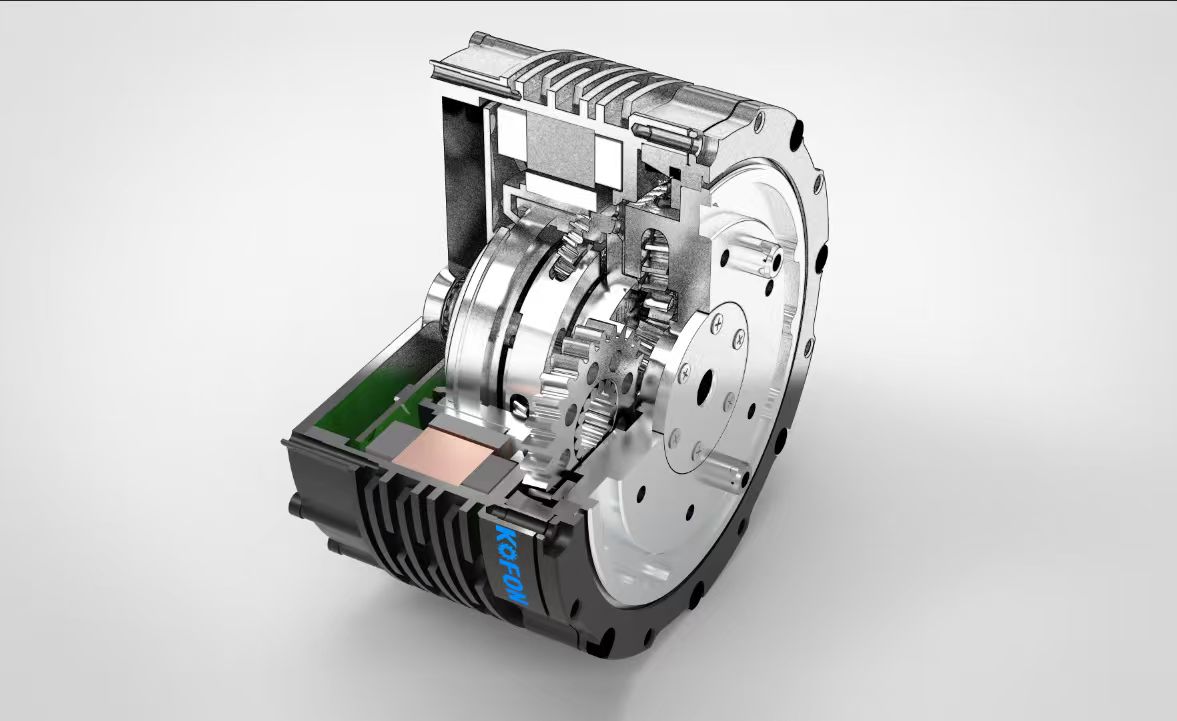







Overload, Longevity, Reliability: Why Factories Will Become the "Home Turf" for Planetary Joint Modules
Time:2026-05-19, Visits:
In the blueprint of the future factory, humanoid robots are moving from display cases to production lines, transitioning from executing fixed programs to handling dynamic tasks. The physical cornerstone of this transformation lies in whether their joints can withstand the rigorous demands of real industrial environments. Analyzing comprehensive performance, cost, and reliability, high-torque joint modules centered on planetary gearboxes are becoming the mainstream choice for joint technology in factory applications. This is not a compromise on precision, but an inevitable pursuit of "industrial-grade durability."
I.Factory Conditions: The "Industrial-Grade" Stress Test for Joints
The factory environment poses three extreme challenges to humanoid robot joints, far exceeding those of laboratory settings:
Continuous Heavy-Duty Cycling: Operating 8-20 hours non-stop daily for tasks like material handling and equipment operation, joints must endure high-frequency, high-load reciprocating motion.
Complex Impact Loads: When moving boxes, interfacing with equipment, or moving on unstructured floors, joints are subjected to unpredictable impacts and vibrations.
Hard Economic Constraints: Factory procurement is cost-sensitive, demanding low failure rates and minimal cost-per-operation over a life cycle spanning years and tens of thousands of hours.
These challenges converge on a core demand: joints must withstand "violent" use while achieving "longevity" and "economy." The high-precision advantage of strain wave gears quickly becomes a disadvantage of "flexspline fatigue" under heavy impact loads. In contrast, the rigid gear structure of planetary gearboxes reveals its robust adaptability as a cornerstone of industrial power transmission.
II. Analysis of Core Technical Dimensions: The "Industrial Resilience" of the Planetary Solution
Planetary joint modules are suited for mainstream factory applications due to their exceptional characteristics across several key dimensions:
1. Durability & Long Service Life: Anti-Fatigue Design Based on Multi-Tooth Meshing
Load Distribution Principle: Planetary gearboxes transmit power through the simultaneous meshing of a sun gear, multiple planet gears, and an internal ring gear. This multi-tooth meshing structure distributes the load across 3-6 planet gears, drastically reducing the stress on individual gear teeth.
Material& Process Assurance: Using case-hardening alloy steels like 20CrMnTiH, surface hardness can reach HRC 60 or higher. Core anti-fatigue indicators—contact fatigue strength and bending fatigue strength—far exceed those of the flexspline materials in harmonic reducers. Under standardized lubrication, their service life can reach more than 20,000 hours by constant running, aligning with industrial equipment maintenance cycles and achieving the durability to "work shifts alongside humans."
2.Ultra-High Structural Rigidity: The Physical Foundation for Precision Stability
Resistance to Deformation: The rigid meshing of the planetary structure provides extremely high torsional stiffness. When a robot handles heavy objects or performs precise assembly, the joint exhibits minimal elastic deformation under load, ensuring stable positioning accuracy of the end-effector.
Impact Resistance: The rigid contact of gears can withstand momentary overload shocks. In cases of unexpected collision or sudden load changes, the planetary gear train effectively absorbs impact energy. Its failure mode tends to be progressive wear rather than sudden fracture, providing valuable fault warning time and preventing catastrophic downtime.
3. Maintainability & Cost Advantage: Compatibility with Industrial Systems
Modularity & Maintainability: Planetary joint modules have an intuitive structure. Damage typically requires only the replacement of standard gears or bearings, supporting rapid on-site maintenance and significantly reducing downtime.
Mass Production Cost Advantage: The design of planetary gearboxes shares technological roots with automotive transmission gears. They can leverage mature, large-scale, low-cost manufacturing supply chains for precision forging, gear hobbing, and grinding. Their unit cost is significantly lower than that of harmonic reducers with comparable torque ratings, clearing the major economic hurdle for the large-scale factory deployment of humanoid robots.
III. Application Scenario Mapping: The "Primary Battlefield" for Planetary Joints
Within the factory, planetary joint modules will dominate the following critical areas:
Lower Limb Joints (Hip, Knee, Ankle): Bear the robot's weight and movement, resisting ground impact and continuous load. Rigidity, impact resistance, and longevity are mandatory.
Waist Rotation Joint: Withstands the highest torsional loads during handling, requiring extreme torsional stiffness and reliability.
Upper Arm Joints: Execute heavy lifting, pushing, and pulling tasks, countering sustained high torque.
For areas like the forearm and wrist, where high precision and lightweight design are paramount, strain wave gears or emerging technologies like magnetorheological solutions may still find their niche, forming a hybrid architecture: "Planetary for mainstream high-torque, Harmonic supplementing for precision."
Conclusion
Factories do not need "art pieces in glass display cases"; they need "iron partners that can bear heavy loads and toil tirelessly." Planetary joint modules, with their inherent rigidity, proven durability, and cost advantages that seamlessly integrate with industrial mass-production systems, perfectly align with the factory's core demand for "industrial-grade durability" in humanoid robots. They represent not just a technological choice, but an inevitable shift in mindset from laboratory thinking to industrialization thinking. When humanoid robots truly step onto the bustling factory floor, the power and endurance driving them will likely come from those robust planetary gears, turning silently within the robot's joint housings.